
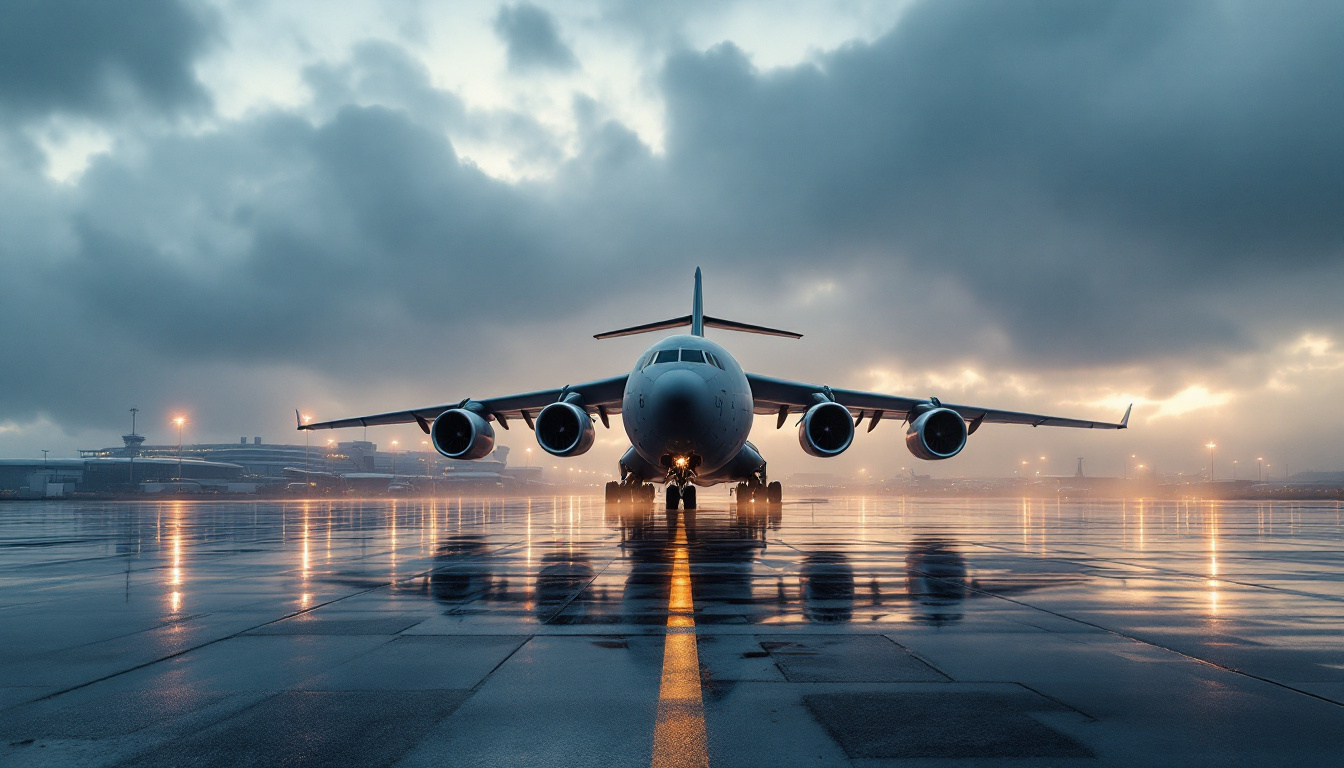
At approximately 10 a.m. Moscow time on Tuesday — 3 a.m. Eastern — a Boeing C-17A Globemaster III, one of the largest transport aircraft in the U.S. military fleet, touched down at Vnukovo International Airport in Moscow, Russia. Flight-tracking data on FlightRadar24 showed the plane had departed Joint Base Andrews in Maryland on Sunday evening around 5 p.m. ET, stopped in Riga, Latvia, and then continued roughly two hours east into Russian airspace.
No one will explain what it was doing there.
The Pentagon referred questions elsewhere. The Air Force referred questions elsewhere. U.S. European Command confirmed they had "no information to provide." The White House, the U.S. embassy in Moscow, and the Russian embassy in Washington did not immediately respond to questions. Kremlin spokesman Dmitry Peskov told reporters he "lacked information" about the aircraft.
So a massive American military transport plane flew from the home base of Air Force One, stopped in a NATO capital, landed in Moscow, and every single entity in both governments suddenly developed amnesia. That's quite a coincidence.
NBC News first confirmed the landing. Newsweek followed. Latvia's Defense Ministry was contacted for comment. Nobody had answers. Nobody had scheduled diplomatic meetings on the books. Nobody could say who was on the plane, what it was carrying, or what the mission was. The C-17A Globemaster III is built to haul troops, cargo, and heavy equipment across continents. It's not the kind of aircraft you accidentally park at a Russian civilian airport.
In normal times, a U.S. military aircraft landing in Moscow would generate immediate comment from the National Security Council at minimum. The absence of any statement at all — from either side — suggests this wasn't a mistake. It was deliberate. And someone, somewhere, made the decision that the American public doesn't need to know the details yet.
The usual suspects in media are already doing what they do — spinning theories, invoking Russia collusion nostalgia, and generally treating the silence as confirmation of whatever they already believed. The more useful question is simpler: what kind of diplomatic or military operation requires a C-17 transport, a layover in Latvia, and total information blackout from two nuclear powers simultaneously?
There are really only a handful of scenarios that fit. Prisoner exchanges. Document transfers. Precursor logistics for a diplomatic meeting not yet announced. Equipment retrieval related to ongoing negotiations. None of them are scandalous. All of them are the kind of thing governments keep quiet until the timing is right.
President Trump explains what is NOT happening in Russia, but refuses to say what is happening behind the scenes
The people who spent four years insisting every contact between Washington and Moscow was evidence of treason will have a field day. Which is an interesting position to hold when you also claim to want diplomacy, de-escalation, and an end to the war in Ukraine. Apparently back-channel communication is vital right up until a Republican administration does it — at which point it becomes suspicious.
The real story isn't that a plane landed. It's that we live in a moment where quiet diplomacy between nuclear powers can't happen without a media apparatus that treats silence as guilt. Every administration in modern history has conducted sensitive operations that weren't announced in real time. Eisenhower did it. Kennedy did it. Reagan's team talked to the Soviets through channels the press didn't know about for months.
A C-17 flew from Andrews to Moscow through Riga. Every official asked about it went quiet. Both governments chose the same response: nothing.
That's not a scandal. That's a tell.