
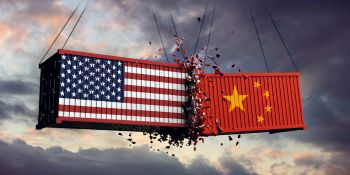
On June 22, 2026, China's Ministry of Commerce added 10 American firms to its export control list. Two of them — MP Materials, based in Las Vegas, Nevada, and USA Rare Earth, out of Stillwater, Oklahoma — are among the few companies in the United States capable of mining and processing the rare earth minerals that go into everything from fighter jets to missile guidance systems.
That's not a trade dispute. That's targeting the supply chain for American national defense.
The sanctions didn't stop at 10 firms. China's Ministry of Finance simultaneously restricted 46 U.S. companies from Chinese government procurement, a list that reads like the Pentagon's Rolodex: Lockheed Martin, Raytheon Missiles & Defence, General Dynamics Land Systems, Boeing Defence, Space & Security, General Atomics Aeronautical Systems, and the Javelin Joint Venture — the 50-50 partnership between Lockheed Martin and Raytheon that produces the anti-tank missiles Ukraine has been burning through for years.
The other eight firms on the export control list are smaller defense and drone contractors scattered across the country: AVEOX in Simi Valley, California; Red Cat Holdings and Teal Drones in South Salt Lake, Utah; IMSAR in Springville, Utah; Jaia Robotics in Bristol, Rhode Island; Ball Aerospace & Technologies in Broomfield, Colorado; Oshkosh Defense in Oshkosh, Wisconsin; and L3Harris Maritime Services in Norfolk, Virginia.
Beijing framed the move as retaliation. On June 9, the Pentagon had added several major Chinese companies to its own restricted list under Section 1260H of the National Defence Authorisation Act, including Alibaba Group Holding, Baidu, BYD, Nio, Unitree Robotics, and TP-Link. Cameron Johnson, a partner at Shanghai-based consultancy Tidalwave Solutions, called China's response a "brushback pitch — a warning against other possible sanctions on China," adding that "this is a reaction to the US' recent blacklisting by the Pentagon."
Trade expert Henry Gao, a professor of law at Singapore Management University, said the sanctions would "likely serve to build leverage for China in the ongoing negotiations with the U.S.," though he cautioned that "in terms of the trade truce, this development introduces additional friction."
The timing is no accident. A planned visit by Chinese President Xi Jinping to the United States is reportedly still on the calendar for September, and a $14 billion arms package to Taiwan remains under review. Xin Qiang, a professor and deputy director of the Centre for American Studies at Fudan University, put it bluntly: "Beijing is making it clear it's not afraid of tactical confrontation." He warned that "if this falls into a vicious cycle, the impact will be extremely negative."
The rare earth angle is what separates this from routine tit-for-tat. China controls roughly 60% of global rare earth mining and closer to 90% of processing capacity. The minerals are essential for manufacturing advanced weapons systems, electric vehicle motors, wind turbines, and consumer electronics. MP Materials operates the only active rare earth mine in the United States, at Mountain Pass, California. Sanctioning it isn't symbolic — it's strategic.
For years, defense analysts and politicians on both sides warned that America's dependence on Chinese rare earth processing was a national security vulnerability. The Trump administration pushed hard on reshoring critical mineral supply chains. Those warnings look less like hawkish rhetoric now and more like a checklist Beijing is working through.
Fifty-six American companies sanctioned or restricted in a single day. Two of them mine the materials we need to build the weapons the other fifty-four manufacture. That's not friction. That's a blueprint.