
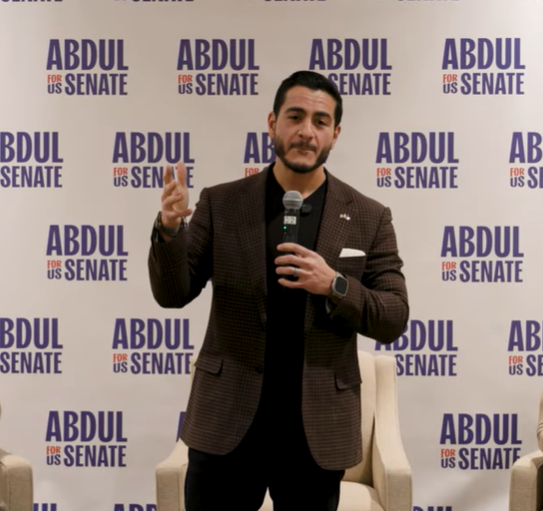
Abdul El-Sayed, Michigan's Democratic Senate candidate, co-authored a research paper at Columbia University Medical School in 2011 that studied birth outcomes among Arab-American mothers in Michigan based on whether the father was Arab or non-Arab. The paper's clinical term for the variable was "interethnic mating."
The internet found it this week.
J.D. Haltigan, a developmental psychopathologist and Honorary Research Fellow at the Heterodox Center, flagged the paper on X with a summary that cuts straight to the point: "Arab mothers who engage in 'interethnic mating' have worse birth outcomes than those who mate with Arab men?" The study examined Michigan birth data from 2000 to 2005 and concluded that non-Arab fathers were associated with higher odds of preterm birth — an odds ratio of 1.18 — and late preterm birth specifically at an odds ratio of 1.24, using Arab-father pairings as the baseline.
The paper went viral almost immediately, and for reasons that should be obvious to anyone who's spent more than five minutes watching how the Democratic Party polices language around race. This is a candidate whose party will end your career for using the wrong pronoun — and his academic contribution to medicine was a study measuring birth outcomes by the ethnicity of the father, framed around whether Arab women "mated" inside or outside their ethnic group.
Drew Pavlou, an activist with a substantial following, didn't mince the framing: "Abdul El-Sayed used to publish race science papers about the dangers of Arab women 'mating' outside the Arab race."
Joanna Rodriguez, Communications Director for the National Republican Senatorial Committee, went directly at the contradiction in a statement to The Post Millennial: "It's ironic that a radical Muslim with documented ties to designated terrorist organizations is scared of interracial mating. Does Abdul El-Sayed stand by his racist fearmongering?"
El-Sayed has not publicly addressed the paper since it resurfaced.
The academic defense writes itself — this is epidemiological research, the language is clinical, and studying health disparities by demographic subgroup is standard practice. Except El-Sayed isn't running for a research fellowship. He's running for the United States Senate in a party that has spent the last decade arguing that studying racial differences in outcomes is itself evidence of systemic bias — unless, apparently, you're the one authoring the study. The odds ratios in the paper are modest. The framing is what makes it radioactive. "Interethnic mating" as a dependent variable reads like something from a journal that would get a conservative academic fired, not a launching pad for a Democratic Senate campaign.
The timing couldn't be worse for El-Sayed. Michigan's Senate race is already contentious, and questions about his affiliations have dogged his political career for years. Rodriguez's reference to "documented ties to designated terrorist organizations" isn't new opposition research — it's a line of scrutiny that has followed El-Sayed through multiple campaigns and that media outlets have repeatedly attempted to contextualize rather than investigate.
What makes the paper's resurfacing different is that it's his own work. Not an association. Not a meeting he attended. Not a donation he accepted. A published study with his name on it, using language his own party would classify as harmful if it appeared in anyone else's research.
Columbia University Medical School, 2011. Odds ratio 1.18. "Interethnic mating." His name is on the paper.