
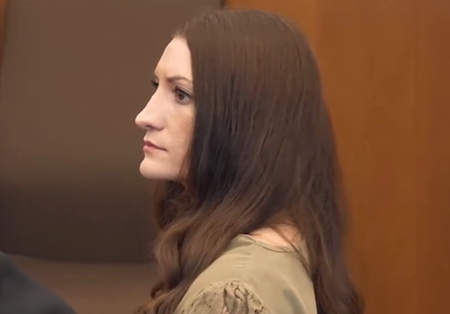
Kevin Reddington, the defense attorney for Lindsay Clancy — the Massachusetts mother who strangled her three children with exercise bands in January 2023 — went on Good Morning America this weekend and asked President Trump to consider issuing a pardon.
Presidential pardons don't apply to state crimes. Reddington is a criminal defense attorney. He knows this.
Clancy was charged with three counts of first-degree murder in the deaths of her children — Cora, age 5, Dawson, age 3, and Callan, just 8 months old — at the family's Duxbury, Massachusetts home. The mandatory sentence if convicted: life without parole. Her defense team argued postpartum psychosis drove her to kill all three of her kids in the basement after sending her husband out of some errands to get him out of the house.
The trial ended Friday in a mistrial. Twelve jurors — nine women and three men — deliberated for 38 hours before sending a note to Massachusetts Superior Court Judge William Sullivan. "With a heavy heart, we report we cannot come to a unanimous decision," the jury wrote.
Reddington told Good Morning America host George Stephanopoulos that he believes the split was 11-1 in favor of an insanity verdict. One holdout juror, in his telling, prevented what would have been an acquittal.
So rather than prepare for a retrial in state court — where this case actually exists, legally speaking — Reddington turned to the cameras and floated something he had to know was impossible. "I'd like to say that perhaps Donald Trump... consider a pardon," he told Stephanopoulos.
Trump, asked about the case in the Oval Office, responded with what sounded like genuine sympathy. "It's a shame. It's a horrible tragedy... Can't be worse," the president said. He also noted, "There'll be a price."
Neither statement amounts to a commitment. And even if it did, the Constitution is clear: Article II grants the president pardon power for "offenses against the United States" — federal crimes. Lindsay Clancy is charged under Massachusetts state law. The president could pardon every federal prisoner in America tomorrow and it wouldn't move Clancy's case a single inch.
Reddington has practiced criminal law for over 30 years. He and Plymouth County District Attorney Timothy Cruz have a professional relationship spanning three decades. He knows the pardon play is a legal dead end. Which means the audience for that Good Morning America appearance wasn't the White House. It was the public.
This is a media strategy dressed up as a legal one. Float the pardon idea on national television, generate sympathy coverage, build pressure on the DA's office before a retrial. Reddington essentially admitted as much, telling reporters he's "willing to listen to Tim... work something out" — referring to Cruz, the prosecutor.
Cruz, for his part, has stayed on message. "Our priority has always been to fight for Cora, for Dawson, and for Callan... seek justice," the Plymouth County DA said at a press conference after the mistrial was declared.
Three children. Named. Ages 5, 3, and 8 months. Strangled with exercise bands in a basement. No one disputes that Lindsay Clancy killed them — not even her own attorney. The question is whether postpartum psychosis made her legally not responsible for ending three lives that hadn't really started yet.
The postpartum psychosis defense is rare and genuinely complex. But the legal system has a mechanism for resolving that complexity. It's called a trial. One just happened. It didn't produce a verdict. Another one will. That's how the process works in a system where the defendant's rights are already protected at every step — appointed counsel, psychiatric evaluation, jury deliberation, the option of a plea.
Asking the president to short-circuit a state murder prosecution isn't a legal argument. It's a cable-news Hail Mary from an attorney who watched his best shot at acquittal fall one juror short.
Clancy is currently housed at Tewksbury State Hospital, a psychiatric facility. She will remain there pending the next steps in her case. Reddington can negotiate with Cruz. Cruz can decide whether to retry. A new jury can deliberate for another 38 hours.
What won't happen is a presidential pardon for a state triple-murder charge. The Constitution doesn't work that way. And every lawyer who passed the bar exam knows it.