
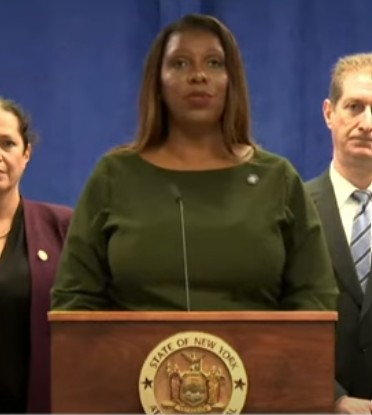
On September 18, Daniel Wiesenfeld received a letter from the New York Attorney General's office threatening him with "professional discipline, as well as civil and/or criminal action." On September 30, he received a second letter — this one with a deadline to confirm he had destroyed documents the office called "confidential and/or privileged information."
Wiesenfeld's response: "These documents are simply evidence and your threats will not compel me to destroy such evidence."
Wiesenfeld is a former assistant attorney general who worked in Attorney General Letitia James's Investor Protection Bureau. He was fired on September 5 — two weeks before the first threatening letter arrived. His crime, according to reporting from the New York Post, was refusing to go along with what he describes as a politically motivated scheme to target Donald Trump and Trump-linked entities.
The story starts with an email. Wiesenfeld sent a message to roughly 2,000 colleagues in the AG's office alleging that his bureau chief, Shamiso Maswoswe, had instructed him to "find and pursue crimes" committed by Trump and his allies "without having a credible reason for targeting these organizations and individuals." The specific targets, according to Wiesenfeld: Trump himself, Truth Social, and the Hewlett Packard merger that the DOJ had already approved.
"If you believe Trump is using the Department of Justice attorneys to prosecute his enemies and further his political interests," Wiesenfeld wrote to his colleagues, "you should find it equally troubling that Tish is doing exactly the same thing."
That email got him fired. What happened next turned this from an employment dispute into something considerably uglier.
The AG's office didn't just let Wiesenfeld go. General Counsel Kumiki Gibson sent the September 18 letter with explicit threats of criminal prosecution. Twelve days later, the second letter demanded proof of document destruction. The message was clear: delete the receipts or face consequences.
Wiesenfeld didn't delete anything. He told the AG's office that if they followed through on their threats and brought the matter to a legal forum, the documents would become public. That's not the response of someone bluffing. That's the response of someone holding a hand he's willing to show.
The AG's office issued a statement: "The office of the attorney general is committed to upholding New York's laws and protecting the rights and freedoms of all New Yorkers, regardless of political beliefs. We strongly reject any assertion to the contrary." The statement does not address the allegation that prosecutors were ordered to find crimes against specific political targets. It does not address the demand to destroy evidence. It does not mention Wiesenfeld by name.
The FBI and DOJ have already met with Wiesenfeld. He spent several hours with both criminal and civil attorneys discussing the claims he first raised in that internal email. The federal investigation into James's office — which also involves mortgage fraud allegations — is not a hypothetical. Investigators are in the room, reviewing what Wiesenfeld kept.
James ran for Attorney General in 2018 on a promise to go after Trump. She said it publicly, repeatedly, before taking office — before reviewing a single case file or receiving a single complaint. The whistleblower allegation isn't that her office happened to investigate Trump. It's that prosecutors were directed to manufacture investigations targeting him without predicate. The cover-up — fire the whistleblower, threaten prosecution, demand document destruction — follows a pattern older than the office itself.
Wiesenfeld was told to destroy evidence. He kept it. The FBI has seen it. James's office is demanding its deletion while simultaneously claiming nothing improper occurred.
The documents still exist.