
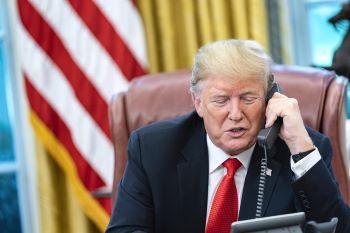
President Trump confirmed this week that he called Israeli Prime Minister Benjamin Netanyahu "crazy" during a phone call — and then explained that he likes the guy anyway and they work well together. That's not a scandal. That's a negotiation.
Cue the media meltdown. A president who tells an ally the truth to his face instead of whispering about him in the green room? Unthinkable.
Here's the backdrop. Iran's new Supreme Leader Mojtaba Khamenei — who took power after his late father — has been in indirect talks with the United States over its nuclear program and the Strait of Hormuz. Trump has been working this angle hard, and by most accounts, the Iranians are taking it seriously. "They have a lot of respect for him," Trump said of Khamenei.
But Israel keeps throwing wrenches into the works. An Israeli airstrike near Tyre, Lebanon on June 2 came right as Washington was trying to line up Tuesday talks between Lebanon and Israel — hosted in our capital, using our diplomatic muscle. The latest fighting between Israel and Hezbollah, which erupted on March 2 when Hezbollah fired rockets, has killed 3,468 people in Lebanon and displaced 1.2 million more. Twenty-seven Israeli soldiers and one defense contractor have been killed in or near southern Lebanon, along with 2 civilians in northern Israel. A nominal ceasefire went into effect on April 17, but you wouldn't know it from the continued strikes around Beirut's southern suburbs, Nabatiyeh, and Khaldeh.
Trump isn't shy about the tension. When asked if a deal with Iran could be wrapped up by Labor Day on September 7, he was characteristically blunt: "I don't know. I mean, I think it could be, but I think it's unlikely."
Honesty. From a politician. Somebody call the Smithsonian.
The reason Trump called Netanyahu "crazy" isn't because he hates Israel. It's because Israel's military operations are complicating the single biggest foreign policy prize on the table right now — a deal that neutralizes Iran's nuclear ambitions without firing a shot. That's a win for every American, and especially for those of us old enough to remember when "dealing with Iran" meant hostages and humiliation.
But here's where it gets interesting. Trump followed up the "crazy" comment by saying, "We've worked very well together. I like Bibi a lot. And I work very well with him." That's not diplomatic double-talk. That's the kind of thing you say about a partner who's being a pain in the neck but is still on your team.
The Associated Press, via Military.com, reported the whole exchange as if it were some kind of rupture in the U.S.-Israel relationship. Please. This is what adults sound like when they disagree. You tell someone they're being crazy, they push back, you hash it out, and you move forward. It's called a relationship. Washington hasn't seen one in decades, which is why they don't recognize it.
Contrast this with how the last administration handled allies. Endless back-channel leaking, passive-aggressive UN votes, and a whole lot of "we stand with Israel" press conferences that meant absolutely nothing when the chips were down. Trump picks up the phone and says what he thinks. Netanyahu knows exactly where he stands. So does Khamenei.
The Al Asad Air Base in Iraq remains a key piece of the American posture in the region, and the Strait of Hormuz — through which a staggering chunk of the world's oil supply flows — is the ultimate leverage point. Trump understands that a deal with Iran protects American interests far beyond the Middle East. It protects your gas prices. It protects the dollar. It protects the retirement accounts that depend on stable energy markets.
Israel is an ally. A good one. But allies don't get to run your foreign policy, and they don't get to blow up your negotiations because their domestic politics demand another airstrike. Trump telling Netanyahu he's being crazy is the most pro-Israel thing he could do — because a president who lets an ally sleepwalk into a wider war isn't a friend. He's an enabler.
The media will spend the next 48 hours pretending this is a crisis. It isn't. It's a president who negotiates like a human being instead of a focus-grouped mannequin.
We should be so lucky that the biggest scandal in American diplomacy is a president who tells the truth out loud.