
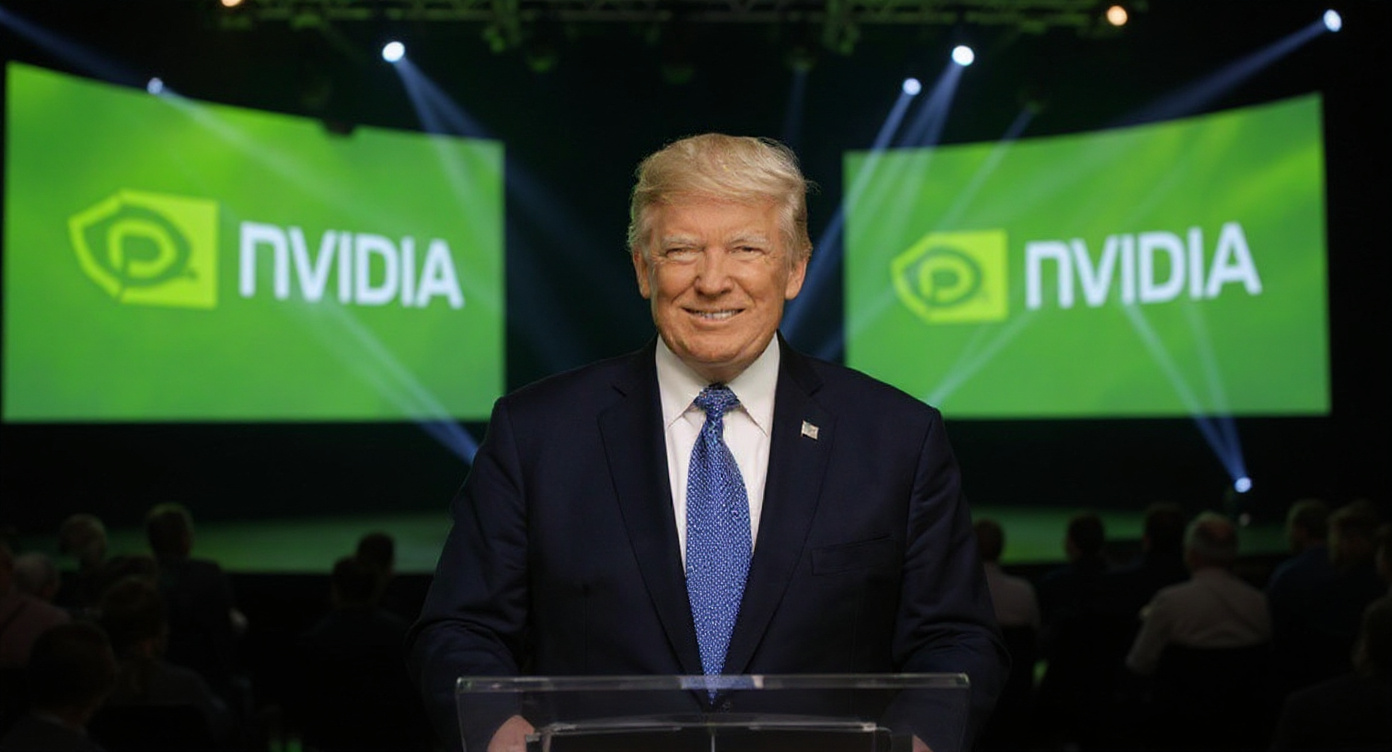
The federal government has spent two years debating whether to regulate AI into submission. On Sunday, the president went over their heads and called the man who builds the chips.
Jensen Huang is the CEO of Nvidia — the company whose processors power virtually every major AI system on the planet. Without Nvidia's hardware, there is no AI race. No ChatGPT, no data centers, no competing with China.
Huang was mid-interview at the All-In Summit in Los Angeles when his phone rang. President Trump was calling. Huang put him on speakerphone — after a brief struggle President Trump couldn't resist making a joke. "The great thing about life is that Jensen can develop the most complex computer chip in the world — and nobody can top any of yours — but he can't figure out how to put me on speaker."
The crowd ate it up.
The All-In Summit, hosted by tech investors Chamath Palihapitiya, Jason Calacanis, David Friedberg, and David Sacks — now serving as White House AI and Crypto Czar — has become the premier stage where Silicon Valley meets Washington without the filter of congressional hearings. The timing of Trump's call wasn't coincidental. Huang and the hosts had just been discussing Anthropic CEO Dario Amodei's public call to "slow the pace at which we improve the capabilities of AI."
"The robots will not be taking over, the AI will not be taking over, the whole thing is a Hoax!" Trump said. He framed the AI doom movement — the loosely organized coalition of academics, regulators, and cautious tech executives who've spent two years warning that artificial intelligence could destroy civilization if Washington doesn't step in — as a campaign, not a concern.
Trump's target wasn't vague. The "safety" lobby includes figures like Amodei whose company stands to benefit from regulatory barriers that would freeze out smaller competitors. The president framed their safety warnings not as genuine concern but as market strategy dressed up in moral language.
"The happiest group is China," Trump added, driving at the core of his argument: every month the United States spends debating hypothetical AI catastrophes is a month Beijing spends building without restrictions. Data centers, in Trump's framing, are the "oil of the next 20, 25 years" — critical infrastructure equivalent to steel mills and railroads — and throttling them with speculative regulation hands the entire industry to a geopolitical rival.
Huang's response was aligned but more precise. He distinguished between documented, traceable AI failures — the kind that can be investigated and corrected — and the broad catastrophic predictions the doom lobby traffics in. He praised Anthropic whistleblower Jacob Coxon for having "great courage" to surface specific concerns, while rejecting the existential catastrophism as unsupported. It was the distinction the doom lobby refuses to make: the difference between fixing problems that exist and regulating problems someone imagined during a TED Talk. His bottom line: "We're going to make sure that everybody wins in the AI race of America. Every industry, every company, every state, every people."
The doom lobby's core claim is that AI poses an existential risk requiring preemptive government intervention. The loudest voices making that claim happen to run companies that would benefit most from licensing regimes and compliance costs that only well-funded incumbents can absorb. The safety argument and the business model point in the same direction.
Watch the interaction between President Trump and Jensen Huang
Chamath Palihapitiya posted afterward: "How crazy is it that we had @POTUS and @JensenHuang debunk a hoax live on stage?" It was a fair summary. The president called the CEO of the world's most important AI chipmaker, on a live stage in Los Angeles, and the two of them dismantled the regulatory panic in real time while the people who built that panic watched from their group chats.
Every previous administration would have formed a commission, held eighteen months of hearings, and produced a 400-page report recommending "further study." Trump called the guy who builds the chips and said let's go.