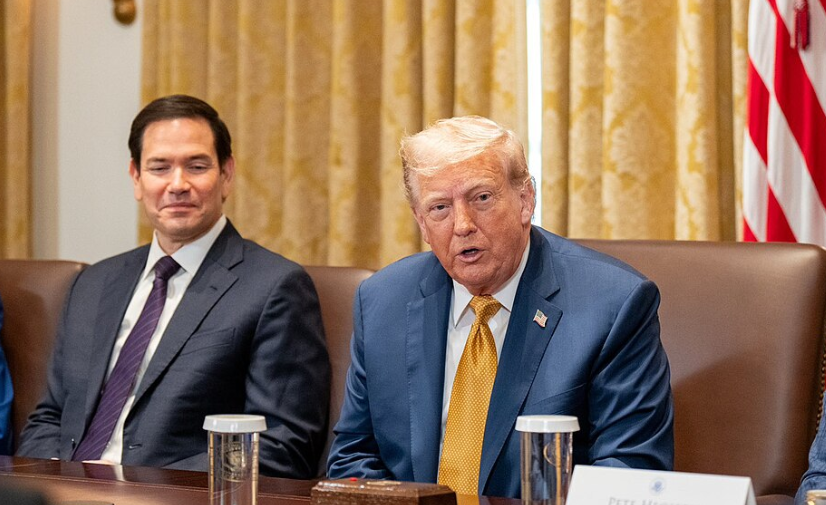
On September 22, President Trump signed a commission making Secretary of State Marco Rubio his permanent National Security Adviser. Sixteen months after taking the role on an acting basis, Rubio now holds both of the federal government's most powerful foreign policy positions simultaneously — something only Henry Kissinger has done, and Kissinger didn't have a Trump-Xi summit on his calendar the next morning.
The timing is not decorative. Trump made the appointment permanent the same afternoon he stood at the United Nations General Assembly and called Cuba "an absolutely failed state" — prompting Havana's delegation to walk out of the chamber. He told the assembly that "freedom will prevail in Cuba" and disclosed that Rubio is "engaged in discussions and is deeply involved in talks with Cuba." Then he turned to reporters afterward and offered a five-word personnel review: "Marco seems to have figured it out."
That's the public side. The structural side is what matters for anyone watching their retirement portfolio and wondering whether this administration has a plan beyond tariff headlines.
Rubio replaced Mike Waltz as acting National Security Adviser on May 1, 2025, after Waltz was removed in the wake of the Signalgate controversy — the episode where senior officials used the Signal messaging app to discuss military strike details against the Houthis in Yemen and a journalist ended up in the group chat. Waltz was reassigned as U.S. Ambassador to the United Nations. Rubio quietly absorbed the NSC portfolio while continuing to run the State Department, serve briefly as acting USAID administrator, and even hold the title of acting archivist of the United States.
The memes wrote themselves. Doctored photos of Rubio as a Spirit Airlines pilot and a Kentucky Derby jockey circulated for months. But the joke obscured what was actually happening: one person was consolidating the entire foreign policy and national security apparatus under a single chain of command reporting directly to the president.
Now consider what that chain of command faces today during the Trump administration's meeting with Xi Jinping.
The Trump-Xi summit agenda covers artificial intelligence, tariffs, critical minerals, the Iran conflict, and Taiwan. Treasury Secretary Scott Bessent and U.S. Trade Representative Jamieson Greer already logged roughly eight hours of pre-summit talks with China's Vice Premier He Lifeng. The American side came away with one formal proposal: a new AI safety notification mechanism.
But the real leverage was set in motion two months earlier. On July 20, Trump signed Executive Order 14415, titled "Securing America's Defense Supply Chains and Ensuring Domestic Acquisition of Critical Materials." The order bars U.S. defense contractors from purchasing critical minerals from China, effective January 1, 2027. It directs the Department of Defense to map supply chains and vet suppliers. It strips contractors of the statutory waivers they'd been using to quietly source components from adversarial nations.
That order landed after Beijing had already demonstrated exactly why it mattered. Earlier in 2026, China imposed stringent controls on exports of rare earths — the critical minerals used in everything from AI chips to missile guidance systems — and successfully pressured Washington to walk back tariffs that had climbed above 100 percent on both sides. The 90-day tariff truce that pulled rates back down expires November 10. Xi's visit is the last clean diplomatic window to decide whether that truce gets extended, modified, or allowed to lapse.
So when Trump formalizes Rubio's authority over the National Security Council one day before the Chinese president arrives at the White House, he's not handing out a promotion. He's showing his cards.
Rubio grew up in Miami's Cuban exile community. His parents — his father a bartender, his mother a cashier and hotel cleaner — settled in the United States in the 1950s. He spent his childhood hearing firsthand what communist regimes do to ordinary people. As a senator, he opposed Obama's Cuba détente. As Secretary of State, he's overseen multiple rounds of sanctions against Havana in 2026, including two rounds in September alone, targeting Cuba's financial, energy, mining, and military sectors. The island has suffered repeated power grid collapses amid chronic fuel shortages.
That's the man now running the National Security Council as Xi sits down across the table.
Michael Lucci wrote in National Review on September 23 that Trump's China strategy is "bigger than tariffs and summits." He's right. Senator Marsha Blackburn's Chip EQUIP Act, introduced in December 2025, would prevent companies receiving CHIPS Act funding from purchasing semiconductors or specialized technology from entities controlled by China, Russia, North Korea, or Iran. The Pentagon has signed production deals to onshore autonomous drone boat manufacturing — one agreement, between U.S. firm ReconCraft and Ukrainian company Uforce, put a production line in Portland, Oregon.
Tariffs make headlines. Supply chain executive orders don't. Personnel decisions that consolidate two of the three most powerful foreign policy roles in a single Cuba hawk's hands — announced the afternoon you humiliate Havana at the UN and 24 hours before the Chinese president arrives — those are the moves that tell you where the strategy actually lives.
The 90-day truce expires in 48 days. Rubio's commission has no expiration date.