
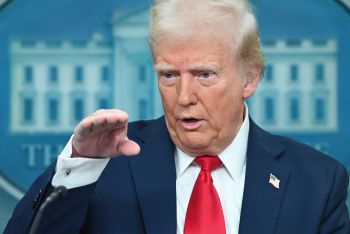
President Trump told reporters aboard Air Force One on Sunday that a nuclear deal with Iran is "imminent." Negotiations restart Monday afternoon in Oman, covering both denuclearization and the Strait of Hormuz — the shipping chokepoint that has been a flashpoint since the war began on February 28.
If it lands, this would be the foreign policy achievement that three administrations said couldn't be done without giving away the store.
Trump laid out the backdrop in his usual style, confirming that a military strike had been ready to launch before diplomacy took over. "We were all set to go, just about at this time right now, and it would have been a massive attack," Trump said. He then explained why the bombs didn't fall. "Would I rather make a deal? I'm not looking to kill people."
The calculus wasn't just American. Trump said both regional allies and Iran itself pushed for talks over strikes. "I said, 'What would you rather do? Would you rather have us do this or not?'" he recounted. "They didn't want us to do it. And frankly, Saudi Arabia didn't want it either." Saudi Crown Prince Mohammed bin Salman, the United Arab Emirates, Qatar, and Israel are all watching Monday's session in Oman with direct strategic interest.
Iranian Foreign Minister Abbas Araghchi is heading into negotiations, but Tehran is already drawing lines. Iranian Foreign Ministry spokesman Esmaeil Baqaei insisted that the Strait of Hormuz would "under no circumstances" return to pre-war arrangements. That's the kind of opening position that either collapses on contact with leverage or hardens into a dealbreaker — and Trump's track record suggests he knows the difference.
"The reason they asked is they think there's a deal," Trump said of Iran's willingness to return to the table. That sentence is doing more work than it looks like. Iran isn't negotiating because they've had a change of heart about nuclear ambitions. They're negotiating because the alternative — a president who had the strike package ready and told them so — isn't theoretical.
The contrast with previous administrations is hard to overstate. The Obama deal shipped pallets of cash to Tehran, kept side agreements secret, and left Iran's enrichment infrastructure intact. The Biden years produced nothing but strongly worded press releases while Iran accelerated its program. Trump's approach: position the military option as credible, make the other side come to you, and negotiate from strength.
Critics will call it reckless brinkmanship. Which is an interesting way to describe a situation where the president had a "massive attack" ready, chose diplomacy instead, got the other side back to the table, and is now talking about denuclearization — the thing the last two presidents either gave up on or pretended to achieve.
The Strait of Hormuz alone makes this significant for every American with a retirement account. Roughly 20 percent of the world's oil passes through that chokepoint. Instability there moves energy prices, which moves inflation, which moves the value of everything sitting in your 401(k). A deal that stabilizes Hormuz and puts Iran's nuclear program on the table isn't just foreign policy. It's your portfolio.