
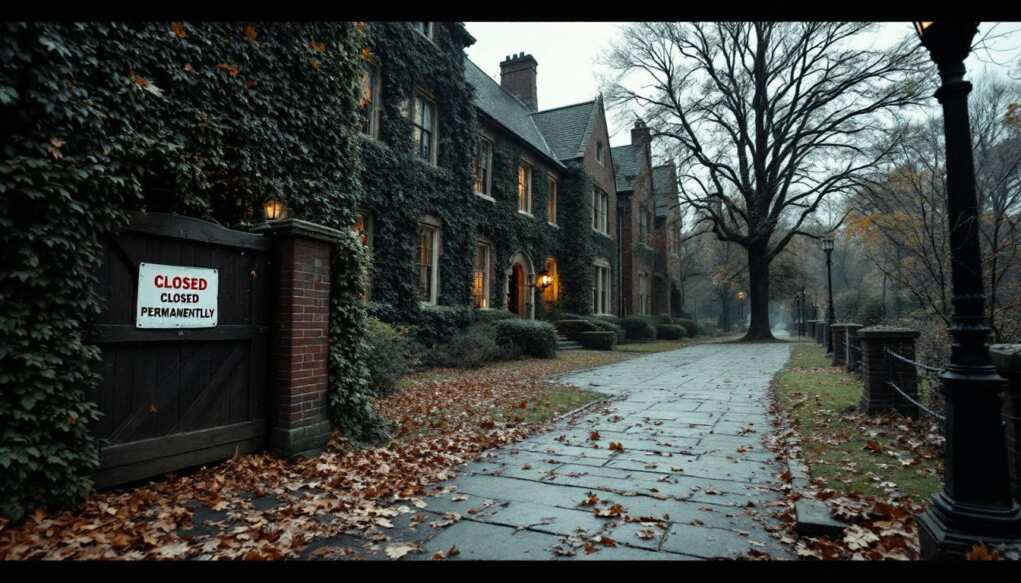
We come not to bury Hampshire College. We come to laugh at its funeral.
Yesterday, after months of pretending everything was fine, the administration at Hampshire College in Amherst, Massachusetts finally admitted what the rest of us have been saying for about a decade. They are closing. Permanently. The no-grades, no-majors, no-requirements, no-standards, no-adults, no-clue utopia of American higher education has run out of runway, run out of donors, and — most importantly — run out of customers. The school that was supposed to reimagine learning has now reimagined itself right into bankruptcy.
And you know what? Good.
Hampshire College was founded in 1970 on the revolutionary idea that grades are oppressive, majors are capitalist, and students should design their own curriculum. The pitch, for anyone unfamiliar with it, went something like this. You pay us $70,000 a year. In exchange, we let you sit around for four years writing a “portfolio” about whatever you feel like. Maybe it’s gender studies. Maybe it’s the semiotics of the skateboard. Maybe it’s a 200-page autobiography of your relationship with your therapist. There are no tests. There are no grades. There is no failing, because failing would be judgmental, and judgment is violence. At the end of it, you get a piece of paper that says you completed the experience of being there.
For a while, this worked. In the 70s and 80s, rich kids who wanted to protest the Vietnam War without ever actually picking up a textbook flocked to Hampshire like it was Woodstock with a meal plan. They produced some famous alumni. Ken Burns went there. The guy who made the Ken Burns documentary effect went there, presumably. Some actors. Some hedge fund guys who will never admit it on LinkedIn. For a brief moment, it was cool.
But here’s the thing about coolness. It ages.
By about 2010, the rich parents who used to write checks to Hampshire started noticing that the kids they were sending weren’t coming back with jobs. Or skills. Or, in some cases, the ability to make eye contact. They came back with portfolios about the lived experience of being on a meal plan and a $280,000 tuition bill that was supposed to, somehow, eventually, result in something resembling an income. It did not.
So parents started saying no. Enrollment started dropping. And Hampshire, instead of responding to market signals the way a sane institution might — you know, by teaching useful things — doubled down. They doubled down on the struggle sessions. They doubled down on the pronoun training. They doubled down on the ideology. By 2019 they were so broke they tried to merge with UMass Amherst, and UMass Amherst — which is not exactly Harvard itself — looked at the numbers and said, politely, no thank you.
Now it’s 2026 and the lights are finally going out. Enrollment has collapsed. The endowment is gutted. The donors, who were mostly old hippies with trust funds, have either died or figured out that maybe their granddaughter would be better served by a plumbing certificate. And the administration has finally admitted the truth that anyone with eyes could see coming from thirty miles away.
Nobody wants what they’re selling.
That’s the whole story. Nobody wants it. The market — that filthy, oppressive, patriarchal, capitalistic market they spent fifty years protesting — has rendered its verdict. And the verdict is that if your pitch to eighteen-year-olds is “come to our school, pay seventy thousand dollars a year, and learn absolutely nothing measurable for four years, all while being yelled at by your classmates for using the wrong word at brunch,” then eventually, even the most guilt-ridden Volvo-driving parent in Connecticut is going to look at you and say maybe community college would be fine.
This is beautiful. This is exactly how this is supposed to work.
For decades, we have been told that higher education is sacred. That you can’t question it. That everything a university does is important because it’s a university. That the professors are geniuses, the administrators are saints, the students are the future, and the bills — oh, the bills — are just the cost of civilization. You had to pay. Shut up and pay.
And what did we get for it? We got Hampshire College. We got schools where the debate team got shouted down for inviting a speaker. We got professors doxxing their own students for going to a Trump rally. We got administrators who cost more than the faculty and produced nothing but HR complaints. We got classes on how white supremacy lives inside mathematics. We got $70,000 a year and, in exchange, we got a generation of young people who cannot change a tire, cannot read a contract, cannot balance a checkbook, but can tell you in fourteen different ways why capitalism is violence.
And now the customers are voting with their wallets.
Hampshire is the first domino. It will not be the last. Across the country, small liberal arts colleges are hemorrhaging students. Oberlin is wobbling. Evergreen is a punchline. Bard is on life support. The entire ecosystem of “you pay us a quarter million dollars and we turn your kid into a red-scarf-wearing lunatic” is collapsing in real time. Because parents are finally — finally — doing the math.
The math says: trade school. The math says: community college and a job. The math says: learn to weld, learn to code, learn a thing that makes the world go. The math says: whatever you do, do not send your beautiful, eager, full-of-life eighteen-year-old to an institution whose admissions pitch is “we will erase your personality and replace it with a political opinion.”
Hampshire College is dead. The market killed it. No amount of DEI administrators could save it. No amount of land acknowledgments could fill the lecture halls. No amount of portfolio-based assessment could pay the heating bill.
Rest in peace, Hampshire. You were exactly as good as the people said you were. Which is to say, not very.
The school that graduated Ken Burns couldn’t graduate itself out of bankruptcy. And honestly, that’s the most American story we’ve read all week.